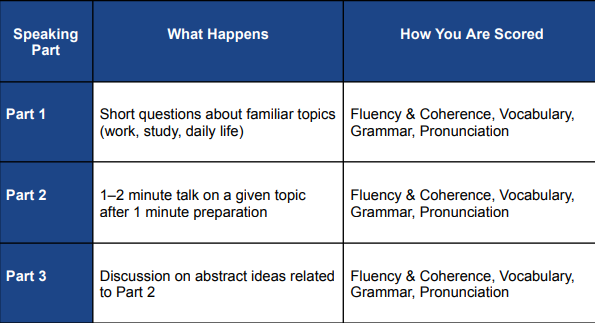
The IELTS Speaking test is a live, face-to-face interview designed to assess your ability to communicate naturally, develop ideas, and use English flexibly.
Scoring high (Band 7+) requires far more than “good vocabulary” — you must show fluency, coherence, topic-specific language, and accurate pronunciation patterns.
This guide breaks down the complete test format and gives research-based IELTS Speaking tips aligned with the official band descriptors examiners use.
The recording status box displays a countdown until the microphone opens. You have 30-40 seconds to prepare, depending on the length of the passage. You hear a short tone. After the tone, start speaking immediately. Do not start speaking before the microphone opens because your voice will not be recorded.
You should speak clearly. There is no need to rush.
Finish speaking before the progress bar reaches the end. The word “Recording” changes to “Completed”.
You are only able to record your response once.
The audio begins to plays automatically. When the audio finishes, the microphone opens and the recording status box shows “Recording”. Speak into the microphone immediately (there is no short tone) and repeat exactly what you heard.
You should speak clearly. There is no need to rush.
Finish speaking before the progress bar reaches the end. The word “Recording” changes to “Completed”.
You are not able to replay the audio. You are only able to record your response once.
The recording status box displays a countdown until the microphone opens. You have 25 seconds to study the image and prepare your response. You hear a short tone. After the tone, start speaking immediately. Do not start speaking before the microphone opens because your voice will not be recorded.
You should speak clearly. There is no need to rush.
Finish speaking before the progress bar reaches the end. The word “Recording” changes to “Completed”.
You are only able to record your response once.
The audio begins to play automatically. You may also see an image related to the audio. After the audio finishes, you have 10 seconds to prepare.
The recording status box displays a countdown until the microphone opens. You hear a short tone. After the tone, start speaking immediately. Do not start speaking before the microphone opens because your voice will not be recorded.
You should speak clearly. There is no need to rush.
Finish speaking before the progress bar reaches the end. The word “Recording” changes to “Completed”.
You are only able to record your response once.
The audio begins to play automatically. You may also see an image.
When the audio finishes, the microphone opens and the recording status box shows “Recording”. Speak into the microphone immediately (there is no short tone) and answer the question with one or a few words.
You should speak clearly. There is no need to rush.
Finish speaking before the progress bar reaches the end. The word “Recording” changes to “Completed”.
You are not able to replay the audio. You are only able to record your response once.
To reach Band 7 or above, you must demonstrate:
• Fluency and Coherence
● Smooth speech
● Logical development
● Minimal hesitation
• Lexical Resource
● Topic-specific vocabulary
● Ability to paraphrase
● Natural expressions
• Grammatical Range and Accuracy
● Mix of simple + complex structures
● Good control with few errors
• Pronunciation
● Clear, understandable speech
● Natural rhythm
● Good stress and intonation patterns
Your strategy must target all four — not just vocabulary.
Most students give short, boring answers. Examiners want something fuller — not long, but developed.
Use FLARE:
F — First sentence (short answer)
L — Link with a reason
A — Add a detail
R — Relate to personal experience
E — End naturally
Example:
Q: Do you enjoy reading?
F: Yes, I do.
L: It helps me relax after work.
A: I mostly read biographies.
R: Recently, I finished one about a famous entrepreneur.
E: It really inspired me.
This becomes a Band 7-level response — extended but natural.
Instead of memorising templates, use a flexible organising tool:
The 4-Box Map
1. Description — Who/What/Where
2. Story — Background or how it started
3. Details — Sensory or emotional details
4. Reflection — Why it was meaningful
This structure gives:
✔ Coherence
✔ Natural fluency
✔ Enough content for 2 minutes
Part 3 requires deeper, analytical answers.
Use IDEA:
● I — Idea (give your opinion)
● D — Develop (explain why)
● E — Example (give a universal example)
● A — Alternative (compare or contrast)
Example:
Q: Should governments invest more in public transport?
I: Yes, absolutely.
D: It reduces traffic and pollution.
E: For example, cities with reliable metro systems have lower car usage.
A: However, rural areas may still rely on cars because distances are bigger.
This is examiner-aligned Band 7–8 speaking.
Most students use general words like “good”, “bad”, “very nice”.
Instead, use topic-specific collocations related to 2024–2025 trending topics:
Technology
● digital skills
● artificial intelligence tools
● data privacy
● screen-based learning
Environment
● carbon emissions
● renewable energy sources
● environmentally conscious
● sustainable lifestyle
Education
● academic pressure
● interactive learning
● lifelong education
● practical skills
Work & Careers
● job satisfaction
● flexible working arrangements
● career development
● professional growth
Vocabulary banks help you rank for keywords like:
● IELTS speaking vocabulary for Band 7
● topic-specific vocabulary for IELTS Speaking
Fillers help you think while sounding fluent:
● That’s an interesting question…
● Let me think for a moment…
● I haven’t considered that before, but…
10-Minute IELTS Speaking Workout
● 2 mins — Answer two Part 1 questions using FLARE
● 2 mins — Describe a random object (fluency training)
● 3 mins — Record a Part 2 long turn (4-box map)
● 3 mins — Answer one Part 3 question using IDEA
This improves fluency faster than long, unstructured practice.
To jump from 6.0/6.5 to 7+, avoid these:
One-sentence answers
Memorised scripts
Repeating the question
Using overly formal language (IELTS Speaking is NOT Writing)
Long pauses while thinking
Band 7 speakers sound natural and flexible, not robotic.

With a 99% success rate, we are dedicated to helping you excel in the PTE Academic exam and achieve your best score on your first attempt.
Get instant replies
+61 481 332 072
Fill out form and we'll get back to you
Copyright © 2025 IPT Brisbane. All rights reserved.
