PTE LOGIN
NAATI LOGIN
speaking picsart aiimageenhancer

About Speaking Section

Speaking tests your ability to produce spoken English in an academic environment.

Speaking item type require you to respond orally using fluent speech, correct intonation, stress and pronunciation that are easily understandable to most regular speakers of the language.

PTE Academic recognizes regional and national varieties of English pronunciation to the degree that are understandable to most regular speakers of the language.

Speaking item types are not timed individually. You can refer to the timer in the upper right-hand corner of the computer screen, “Section Time Remaining,” which counts down the time remaining for the speaking section.

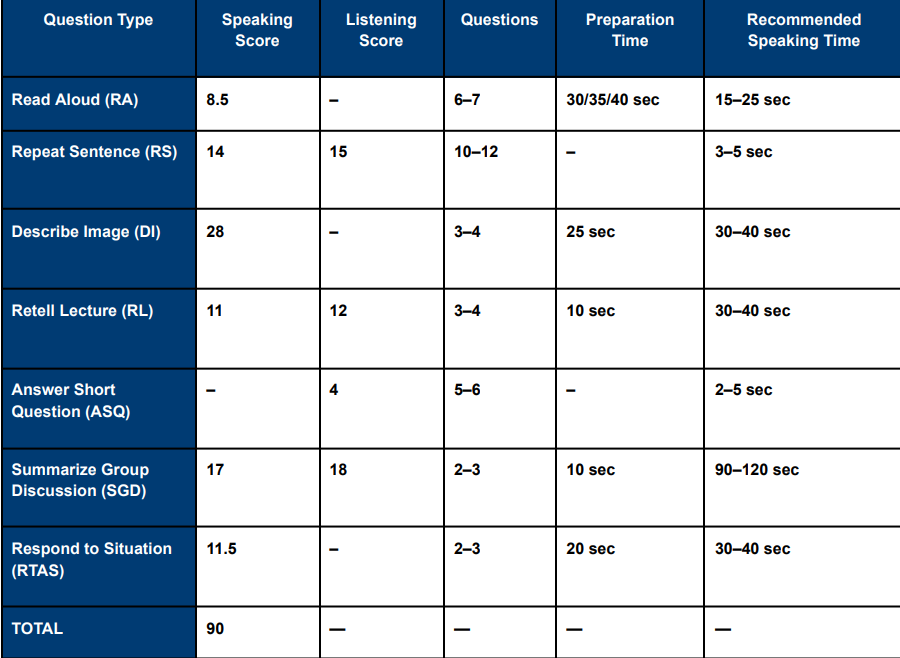
Speaking Question Types

Read Aloud: Tips
1. Practice pausing at punctuation to improve fluency and clarity in PTE Read Aloud.
2. Preview the text to identify difficult words before recording starts.
3. Maintain a natural, steady speaking pace for higher PTE pronunciation scores.
4. Emphasize word endings and vowel sounds to boost pronunciation accuracy.
5. Keep speaking smoothly without correcting mistakes to maximize fluency points.


Repeat Sentences: Tips


1. Listen for the sentence meaning first, not each word, to improve accuracy in PTE Repeat Sentence.
2. Use chunking—group words into 3–4 word phrases to recall the sentence more easily.
3. Keep your tone steady and speak without hesitation to maximise fluency and oral clarity.
4. If you forget a word, keep speaking with the correct rhythm instead of pausing or correcting.
5. Train your memory with daily shadowing and echoing exercises to strengthen sentence retentio

Describe Image: Tips (In this task you have to describe the image presented on your screen: Graph, process chart, Maps, Abstract Image)
1. Start with a clear overview sentence that describes the main idea of the image for a strong PTE Describe Image response.
2. Follow a fixed template to stay structured and fluent, even when the image looks complex.
3. Focus on key features, trends, or standout elements instead of trying to describe every detail.
4. Maintain steady fluency by speaking continuously for 30–35 seconds without long pauses.
5. End with a simple concluding sentence to show completion and boost overall coherence.
Retell Lecture: Tips

1. Focus on capturing the main idea of the lecture rather than every detail to deliver a high-scoring PTE Retell
Lecture response.
2. Note down keywords, numbers, and transitions to structure your retell clearly and logically.
3. Use simple linking phrases like “first,” “next,” and “finally” to maintain fluency and coherence.
4. Speak for 30–40 seconds with steady pacing and avoid long pauses or corrections.
5. End with a clear concluding line to show completion and strengthen your overall content score.

Short Answer Questions: Tips
1. Give short, direct answers—one or two words are enough for high PTE ASQ scores.
2. Focus on general knowledge questions rather than grammar or full sentences.
3. Listen for keywords in the question to identify the most logical, common-sense answer.
4. Respond immediately without hesitation to maintain strong fluency.
5. Build vocabulary for everyday topics like objects, professions, and simple facts to improve accuracy.

Strategies For Speaking

Tips & Tricks

1. Identify the main problem quickly and respond directly to what the situation is asking.
2. Use a simple structure—state your action, explain why, and describe the outcome.
3. Speak naturally in the first person (“I would…”) to keep your response clear and realistic.
4. Use linking words like “first,” “then,” and “finally” to make your answer organised and fluent.
5. Stay calm and confident—focus on giving a reasonable solution rather than a perfect one

1. Take structured notes for each speaker separately — capture the main idea, not every word. This helps you
organize your response clearly and avoids mixing up ideas.
2. Use a simple summary template to connect ideas smoothly and boost fluency. A good template turns raw
notes into a coherent spoken response.
3. Include a clear conclusion at the end of your summary to show completeness. Ending with a conclusion
strengthens your content and coherence score.
4. Avoid writing everything — focus on keywords, arguments, and examples to save time. Trying to note down
every sentence leads to messy notes and lost marks.
5. Practice connecting points with linking phrases so your speech flows naturally and fluently. Good linking
improves fluency and makes your response easier for the examiner to follow

For this item type, you must listen to a short group discussion and deliver a clear spoken summary of its main ideas.
The audio plays automatically. After it ends, you get a brief preparation time, and then the microphone opens with the
status “Recording”. Start speaking immediately after the beep.
Your summary should cover the main topic, the key points, and any important opinions or conclusions shared by the
speakers.
Speak clearly and use the available time to give a structured, fluent summary.
Finish before the progress bar ends. You cannot replay the audio, and you only get one chance to record your
response

For this item type, you must respond to a given situation or scenario with a clear, natural, and relevant answer. You
will receive 10 seconds of preparation to understand the prompt and plan your response.
When the microphone opens, begin speaking immediately and explain what you would do, how you would handle the
situation, or what actions you would take.
Keep your answer logical, organised, and easy to follow. Speak in the first person and stay directly focused on the
scenario.
Use your full speaking time but avoid long pauses. You cannot replay the prompt or re-record your answer, so deliver
your response smoothly and confidently.