PTE LOGIN
NAATI LOGIN
writing picsart aiimageenhancer

About Writing

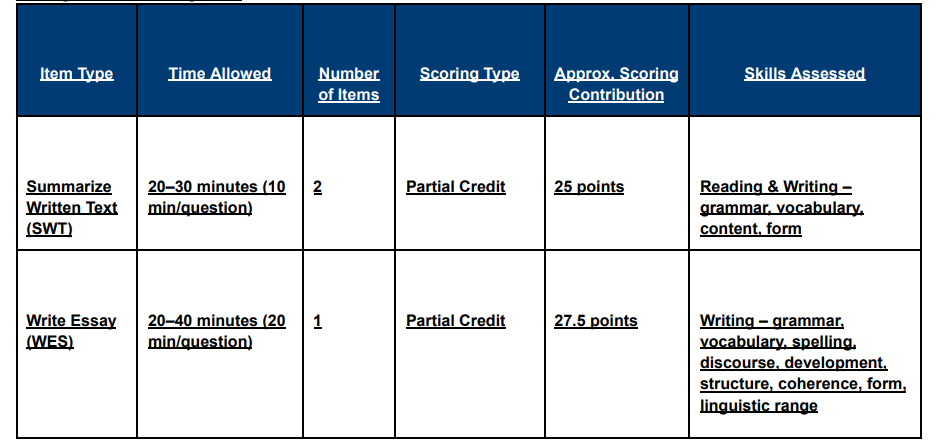
Writing tests your ability to produce written English in an academic environment.

English using correct grammar and spelling. PTE Academic recognize English spelling conventions from the United States, the United Kingdom, Australia and Canada.
However, one spelling convention should be used consistently in a given response. The total time to complete the writing sections is 40, 50 or 60 minutes, depending on the combination of items in a given test.
Writing item types are timed individually. You can refer to the timer in the upper right hand corner of the computer screen, “Section Time Remaining,” which counts down the time remaining for each time.
Speaking Question Types

For this item type, you need to read a short passage and produce one clear sentence that expresses the author’s main
idea. The simplest approach is to pick 3–4 important lines from the passage that contain the central argument and key
supporting points.
Once you have these lines, connect them using an appropriate connector such as which, while, because, as a result,
or therefore to form a smooth, logical sentence.
To strengthen your response and avoid repetition, use 4–5 synonyms throughout your summary while keeping the
meaning accurate.
Stay within the 75-word limit, maintain correct grammar and punctuation, and ensure the final sentence is clear,
coherent, and reflects the main message of the passage.

For this task, write a 200–300 word essay in 20 minutes using a simple 4-paragraph structure. Identify the question
type quickly and keep your ideas clear and easy to follow. Use basic connectors for flow and add a few synonyms to
show vocabulary range. Focus on grammar, structure, and coherence rather than complex ideas—keep it simple,
organised, and error-free.

Tips & Tricks

Strategies For Writing

1. Find the main idea first — locate the topic sentence or the line that controls the whole passage.
2. Pick the 3–4 most important lines that support the main idea and ignore all examples or extra explanations.
3. Join your key points with one strong connector like which, while, because, as a result, or therefore to create
a smooth single sentence.
4. Use 4–5 smart synonyms to show vocabulary range without changing the meaning of the original idea.
5. Check grammar, punctuation, and word limit to make sure your single sentence is clear, accurate, and under 75 words.

1. Stick to a simple 4-paragraph structure so your ideas stay organised and clear.
2. Use easy, error-free sentences instead of trying to write complex grammar.
3. Add a few synonyms in each paragraph to show vocabulary range without risking mistakes.
4. Use basic connectors like firstly, moreover, however, and in conclusion for smooth flow.
5. Answer the question directly and avoid unnecessary ideas—keep it focused and coherent.